Dirt Cheap: How Falling Wholesale Prices Are Crushing the Growers Who Built This Industry
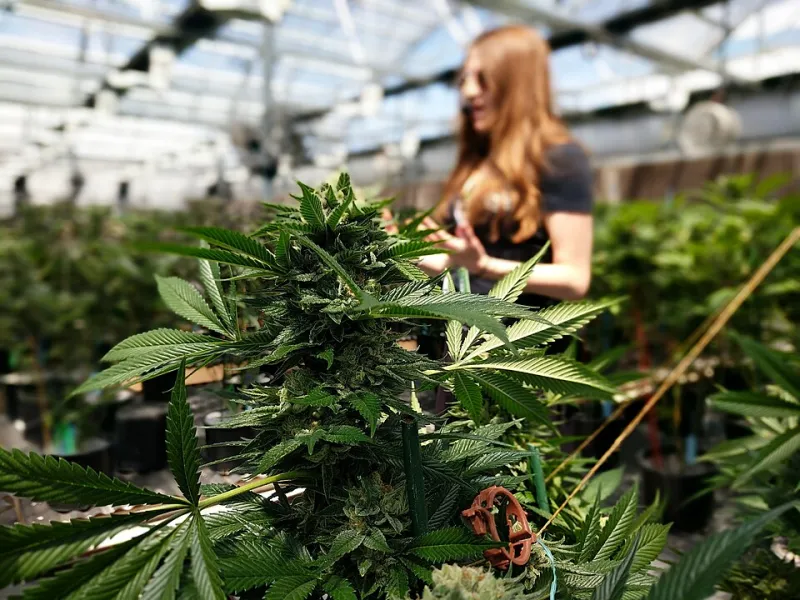
Photo: Cannabis Tours, CC BY-SA 4.0, via Wikimedia Commons
There's a number that keeps coming up in conversations with cannabis cultivators right now, and it's not a good one. In California, wholesale flower that was fetching $1,200 to $1,500 per pound just four years ago is moving — when it moves at all — for somewhere between $300 and $600 today. In Colorado, the story is roughly the same. Oregon? Even worse. The math that made licensed cultivation look like a viable business has been quietly rewritten, and a lot of growers are only now realizing they've been working under the wrong equation for years.
This isn't a blip. It's a structural shift, and the people absorbing the pain are the cultivators — the ones who actually grow the plant, who invested in land and lights and licenses and labor, and who now find themselves trapped in a market that increasingly doesn't care how good their product is.
How We Got Here
The short version: supply exploded and demand didn't keep up.
When states started handing out cultivation licenses at scale, the assumption — at least among investors and optimistic operators — was that legal cannabis would rapidly absorb the illicit market. That hasn't happened at the pace anyone projected. Consumers are price-sensitive, and the gray and black markets have proven stubbornly resilient, especially in high-tax states where a legal eighth can cost twice what someone's plug charges.
At the same time, indoor and greenhouse operations proliferated. Yields improved. Technology got better. More pounds started chasing fewer buyers. Dispensaries gained leverage. Multi-state operators with deep pockets could afford to undercut smaller cultivators just to move volume and hold shelf space. The wholesale market became a race, and the finish line kept moving further down.
"We were told to grow more, scale up, get efficient," says one mid-sized outdoor cultivator in Northern California who asked not to be named. "So we did. And then the price dropped anyway. There's no floor. Nobody told us there was no floor."
The Scale-Up Trap
The conventional wisdom — the advice you'll still hear from consultants and investors — is that cultivators need to scale aggressively to survive margin compression. Get big enough, the logic goes, and your cost-per-pound drops low enough that you can still turn a profit even at depressed wholesale rates.
For some operators, that's worked. Large-scale, highly automated indoor facilities in states like Michigan and Nevada have managed to drive production costs down into the $150–$250 per pound range, which at least leaves something on the table. But for the majority of cultivators — the mid-tier operations running 5,000 to 20,000 square feet — scaling up isn't a solution. It's just a more expensive version of the same problem.
Capital requirements for meaningful expansion are brutal right now. Traditional lenders still won't touch cannabis. Equity investors want returns that a compressed wholesale market can't realistically deliver. And taking on debt to grow more of a commodity that's actively losing value is, as one Oregon grower put it, "like borrowing money to dig a faster hole."
The operators who scaled without securing guaranteed offtake agreements or vertical integration have largely found themselves in worse shape than before — more overhead, more payroll, same punishing prices.
The Direct-to-Consumer Pivot (And Why It's Harder Than It Sounds)
The other play is going direct. Skip the middlemen, build a brand, get your flower onto dispensary shelves under your own label, maybe even open a retail location. If you can command premium pricing through brand recognition and consumer loyalty, you're no longer competing purely on cost.
It's a real strategy. There are cultivators doing it successfully — mostly in markets like California and Massachusetts where craft positioning and terroir-forward marketing have found receptive audiences. Sun-grown, small-batch, single-origin: these narratives resonate with a certain segment of cannabis consumers the same way they resonate with wine and coffee drinkers.
But building a brand takes time and money that most cultivators don't have. It requires marketing expertise, retail relationships, and a product consistent enough to build a reputation on. And in many states, the regulatory structure actively works against it — limiting where and how cultivators can sell, restricting advertising, and making it legally complicated to operate across the supply chain without the right licenses.
"Everyone says 'just build a brand' like it's simple," says a boutique indoor grower in Massachusetts. "But we're farmers. We know how to grow. We don't necessarily know how to do influencer marketing and negotiate shelf placement and manage a loyalty program. Those are completely different skills."
Some cultivators are finding middle ground by partnering with established brands or joining cooperative-style networks that give smaller growers collective leverage in the marketplace. It's not a perfect solution, but it's a creative one — and it speaks to the kind of industry collaboration that platforms like Weeds Network exist to facilitate.
Who's Actually Making It Work
Look across the industry and a few patterns emerge among the cultivators who are holding on.
Diversification is a common thread. Growers who aren't entirely dependent on wholesale flower — who also sell trim for extraction, partner with processors, or supply multiple product categories — have more buffers when any one revenue stream softens.
Relationships matter more than ever, too. Cultivators with long-standing dispensary partnerships, the kind built on trust and consistency rather than lowest-price bidding, are faring better than those trying to break into new accounts in a buyer's market. In a commoditized environment, being a reliable, known quantity has real value.
And then there's the quality play — not as a brand strategy, but as a pure margin strategy. In markets where mid-grade wholesale has completely collapsed, top-shelf indoor is still commanding a meaningful premium. Growers who have invested in genetics, cultivation technique, and post-harvest handling are finding that the gap between premium and commodity pricing has actually widened, even as average prices fell.
The Ones Who Didn't Make It
For every cultivator finding a path forward, there are others who've already closed or are weeks away from it. License surrenders are up in California. Colorado has seen a steady attrition of smaller grows. Oregon's oversupply crisis has been widely documented and is nowhere close to resolution.
The operators who are folding aren't necessarily bad growers or bad businesspeople. Many of them made reasonable decisions based on reasonable projections that the market simply didn't validate. They got licensed during a window when wholesale prices were still livable, built infrastructure accordingly, and watched the numbers slide out from under them.
The industry doesn't talk about these failures enough. The narrative tends to focus on success stories, on the brands breaking through and the operators expanding. But the wholesale collapse is real, and the human cost — lost savings, shuttered operations, workers without jobs — deserves more attention than it gets.
What Comes Next
Wholesale price compression in cannabis isn't going to reverse itself. That's the hard truth. The structural dynamics driving it — oversupply, regulatory barriers to consolidation, illicit market competition, slow consumer market growth — aren't going away in the near term.
What might change is the shape of the industry that survives. Fewer, larger cultivators dominating commodity wholesale. A smaller but viable craft tier serving premium retail. And a whole lot of middle-ground operations that couldn't find a lane either way.
For cultivators still in the game, the window to adapt is narrowing. The growers who make it through this period will be the ones who figured out — sooner rather than later — that growing great cannabis is only half the job. The other half is building a business model that doesn't depend on someone else deciding what it's worth.